From Bryan Hoch:
The pitch that sent the Yankees trudging off the field with their eighth extra-inning loss of the season sailed up and away out of Fernando Cruz’s hand. But when Aaron Boone evaluated how they had gotten to that point, the manager refused to raise a finger toward his pitching staff.
That has been keeping the Yankees afloat for weeks, with a starting rotation handing off to relievers who have gamely shouldered increasing workloads.
Boone pointed instead at the Bombers’ diminished lineup, which has struggled to put crooked numbers on the board — a situation that creates outcomes like their 2-1 11-inning loss to the White Sox on Thursday afternoon at Rate Field.
“We have to score a freaking point,” Boone said. “The pitchers again did their job. The bullpen was good, including Cruz. We’ve got to score. That’s the story, the beginning and end of it. We’ve got to find a way.”
Two of the biggest gut punch losses of the season happen to be back-to-back, which isn’t fun!
Just four more games to get through until the deadline! They need some hitters so badly!
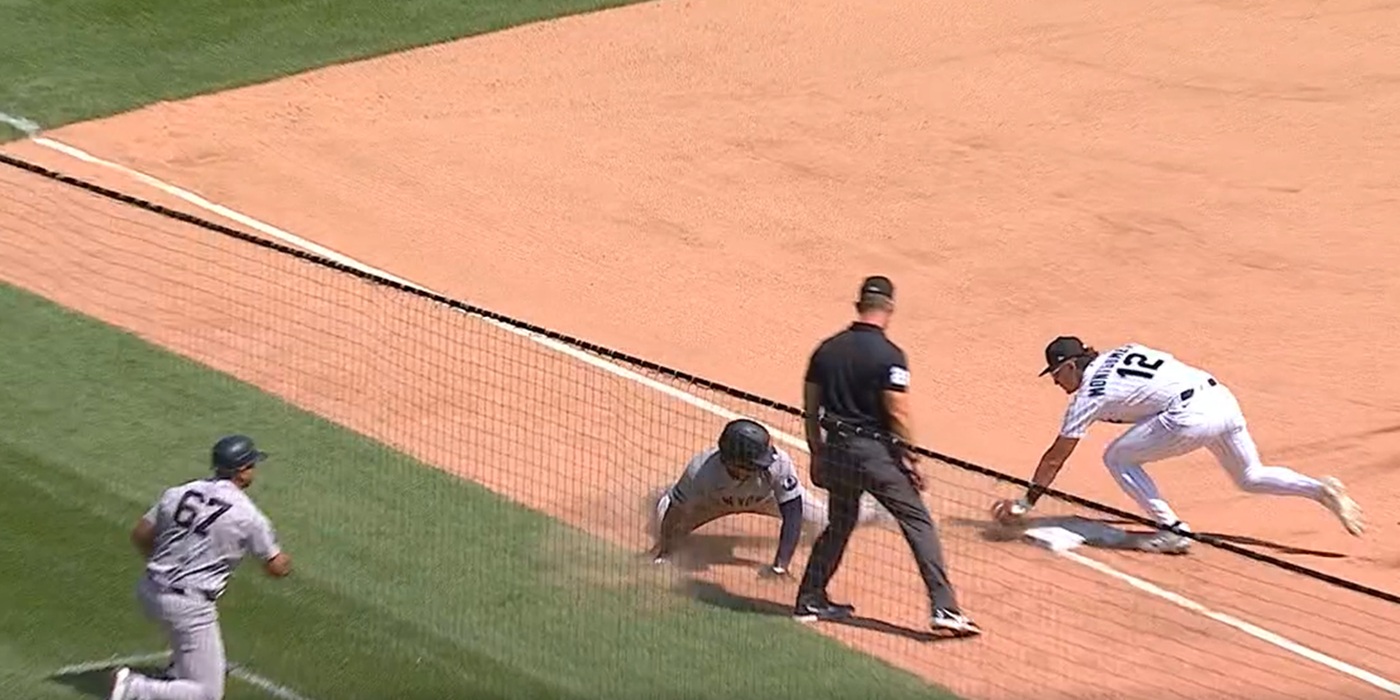
Featured image is Dominguez over-sliding third base by MILES on what should have been a leadoff triple.
About the Author

A repost in reply to BF’s question from the last couple threads/days, in re: how many wins Judge actually contributes to this team.
I suspect the discrepancy between Judge’s WAR and the team’s W-L with/without him is because WAR ignores context, while actual W-L is entirely context dependent. That is, Judge’s WAR is based on the expected impact of his own individual events as if he were on any team, neglecting the unfortunate-for-him fact that he’s on the Boone/Cashman Yanks.
– The Yankees are a slightly below average team without Judge, getting outscored at the margins in most games. A 76 win Pythag is a run differential of about -45 to -50 on the season, or about -0.3 per game. Compared to a replacement level player, Judge’s career wRC/162 is +124 (+0.76/game). So absent context, you’d expect Judge to transform the Yankees from a -46 run differential to a +68 run differential, which is a swing of about 12 games, to an 88 win team.
– “Replacement level” can take on new meaning under Cashman and Boone. Particularly in 2023, they got a lot of below-replacement-level production from guys who made their way through the outfield for chunks of the year: Jake Bauers (-0.9 bWAR), Everson Pereira (-0.6 bWAR), Aaron Hicks (-0.5 bWAR), and for a portion of the year, Waldo (-1.5 bWAR). So WAR isn’t giving Judge the credit for the fact that his actual replacements stink worse than a routine AAA callup.
– The Yankees have underperformed their Pythag every year since 2022, which I believe is a consequence of poor roster design by Cashman and poor in-game management by Boone. Judge’s offensive production, at nearly 3/4 of a run per game, can make a close lead Boone-proof or bullpen-proof, and can make an early lead WOE-proof.
All told, while Judge’s production averages 8.7 bWAR / 162 in the abstract universe, it might easily mean 12 or more wins for these Yankees. And just think about how many more wins he could bring the team if he didn’t stupidly mismanage his injuries.
How can we judge a manager WAR? Because between stupid in-game decisions, the inability to plan ahead (which cost us 2 games this week), and the poorly coached players (like sliding over 3b, or a C throwing a ball into LF with 2 outs in extra innings or etc etc) our manager has gotta be hugely negative.
I’d suggest starting with a difference between Pythagorean expected W-L and actual W-L. The Pythag is based on run differential and how that has historically correlated with W-L. If a team is underperforming its Pythag then it is not doing the things it needs to win close games.
You could also try computing an expected run differential based on the context-independent expected run value of every individual event, and compare that to actual W-L. Depending on how much you believe in context independence, you could change how you compute the expected run value – whether basing it on the outcome (1B, 2B, SB, CS, etc) or the physical parameters (batted ball data, etc).
That said, it’s tough to completely separate a Manager’s value from the GM’s/FO’s – Boone can only play the guys who Cashman puts on the roster, and the fundamentals of the callups are dependent on the coaching/development they got lower in the organization which is under the FO’s control.
And now for some not so good news. Will Warren vs Imanaga
P Goldschmidt (R) 1B
B Rice (L) DH
A Rosario (R) 3B
J Domínguez (S) RF
T Grisham (L) CF
A Volpe (R) SS
S Jones (L) LF
A Sánchez (R) C
J Caballero (R) 2B
Ruh-roh. Now we need to wait to find out which one it is:
(a) Is Jazz out until the moment the Yankees rights to him end, or…(b) was Jazz terminal injured running to first, with 27 minutes left to live?
Where’s Max?
Seriously, the Yankees’ RH hitters have been contributing so little, Jones should play every day. He’s probably the best defensive OFer on the current roster.
Jazz’s injury was just cramps. I think this is just that Imanaga is a lefty and on a heater.
Two runs last 22 innings both on Manfred Mann, 1-15 RISP. Boone today hopes the worm turns offensively. And this offense is offensive.
“How can we judge a manager WAR?”
It’s tough, but I can imagine tracking obviously bad decisions on the field. Some are easy – oversliding bases (why is that on my mind?) , failed bunts, and getting picked off are easily trackable, they don’t even require thought. Others require a system, but not really judgment – you could code in situations where you don’t do one thing or don’t do another – getting thrown out at third stretching or stealing with two outs, throwing to the wrong base in various situations. Finally, there are things that require contextual judgment, but we do that for errors and batter swings now anyway, right?
Those things aren’t strictly always the manager’s fault, but spread over all the players on the team they are, they reflect a level of preparedness. Comparing the results for on a team by team basis might suggests that the outliers have managers that are particularly good or particularly bad at preparing their team to play.